
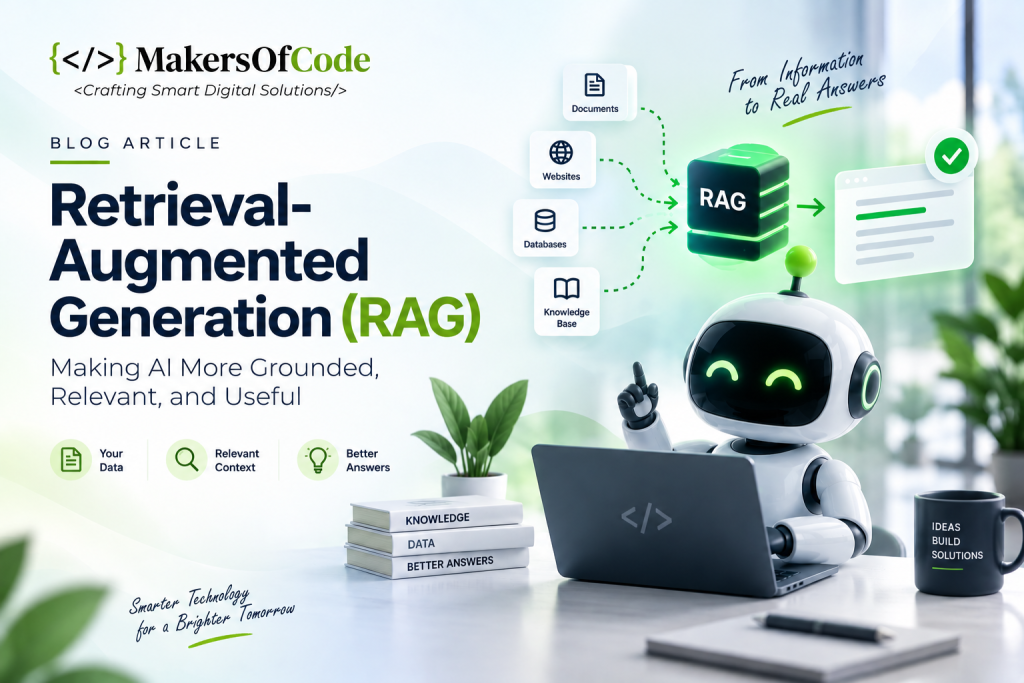
Retrieval-Augmented Generation (RAG): Making AI More Grounded, Relevant, & Useful
Artificial intelligence has become remarkably good at generating human-like responses. Large Language Models (LLMs) can write, summarize, translate, explain, and reason across an impressive range of topics. Yet, when businesses try to use these models with their own data, an important limitation quickly becomes apparent: An AI model can only answer reliably with information it has access to. A company’s latest product documentation, internal policies, customer knowledge base, technical manuals, project records, or private databases may not be part of an LLM’s training data. Even when the model knows something about a particular subject, its knowledge may not reflect the latest version of that information. This is one of the problems that Retrieval-Augmented Generation (RAG) is designed to address. Rather than expecting an AI model to know everything, RAG allows it to retrieve relevant information from an external knowledge source and use that information while generating a response. That shift—from remembering information to retrieving information when needed—has become an important approach to building practical AI applications. What exactly is RAG? Retrieval-Augmented Generation is an architecture that combines two capabilities: In a conventional LLM application, a user asks a question and the model generates an answer based primarily on what it learned during training. A RAG application introduces another step. The system first searches a connected knowledge source for information relevant to the user’s question. The retrieved information is then supplied to the language model as context. The model uses that context to formulate the final response. A simplified flow looks like this: User Query → Retrieve Relevant Information → Provide Context to LLM → Generate Response The model is still responsible for understanding and generating language. The retrieval system provides the information it needs to answer within a particular context. A Simple Example Consider an organization with hundreds of internal documents covering HR policies, employee benefits, leave rules, security procedures, and operational guidelines. An employee asks: “How many days of leave can I carry forward to next year?” A general-purpose AI model cannot be expected to know the company’s internal policy. With RAG, the application can search the organization’s approved documents, locate the relevant leave-policy section, and provide that content to the LLM. The model can then respond based on the retrieved policy. The important point is that the AI didn’t need to memorize the company’s entire documentation. It looked up the relevant information at the time of the question. This same principle can be applied to product documentation, customer support, software documentation, research material, contracts, knowledge bases, and many other information sources. How a RAG System Works A production RAG system usually involves several components working together. Although implementations vary, the process can generally be understood through two phases: building the knowledge base and answering user queries. 1. Preparing the Knowledge Base The process begins with the information the AI application needs to understand. This information might come from: Before this information can be retrieved effectively, it needs to be processed. 2. Chunking the Content Large documents are generally divided into smaller pieces called chunks. For example, a long technical manual could be divided into sections covering installation, configuration, troubleshooting, authentication, and API usage. The goal is not simply to split text into arbitrary pieces. Good chunking attempts to preserve enough context for each section to remain meaningful while keeping retrieval precise. This is one of the areas where RAG implementations can differ significantly. 3. Creating Embeddings The chunks are then converted into numerical representations known as embeddings. An embedding represents the semantic characteristics of a piece of content in a mathematical form. This allows the system to identify content that is conceptually related, even when the wording is different. For example, a user might search: “How can I change my account password?” while the documentation says: “Instructions for updating user credentials.” A semantic retrieval system can recognize that these are related concepts even though the exact words don’t match. 4. Storing the Information The embeddings and associated information are stored in a system that supports similarity search. This may be a dedicated vector database or a conventional database/search platform with vector-search capabilities. Metadata can also be stored alongside the content—for example: This metadata becomes useful when the application needs more controlled retrieval. 5. Retrieving Relevant Content When a user submits a question, the query is processed and used to search the knowledge base. The system identifies the pieces of information that are most relevant to the question. In more advanced implementations, retrieval can involve several techniques, including semantic search, keyword search, metadata filtering, and reranking. The objective is straightforward: Give the language model the right information—not simply more information. 6. Generating the Response The retrieved content is passed to the LLM along with the user’s question. The model can then generate an answer using the retrieved context. This is where the two parts of RAG work together: Retrieval finds the information. Generation turns that information into a useful response. Why RAG Has Become Important The growing interest in RAG is closely connected to the way organizations are adopting generative AI. Businesses rarely want an AI assistant that only answers general questions. They want AI to work with their specific information. That could mean a support assistant trained around product documentation, an internal knowledge assistant connected to company policies, or a developer assistant that understands an organization’s technical documentation. RAG provides a practical way to connect these information sources with modern language models. Keeping Information Current One of the advantages of RAG is that the knowledge source can be updated independently of the underlying language model. If a company releases a new product manual, the new document can be processed and added to the knowledge base. There is no inherent need to retrain the entire language model simply because a document has changed. Working With Private Knowledge Organizations often have information that isn’t publicly available. RAG applications can be designed to retrieve information from authorized internal sources, making them useful for enterprise-specific AI experiences. However, this requires proper