Artificial intelligence has become remarkably good at generating human-like responses. Large Language Models (LLMs) can write, summarize, translate, explain, and reason across an impressive range of topics. Yet, when businesses try to use these models with their own data, an important limitation quickly becomes apparent:
An AI model can only answer reliably with information it has access to.
A company’s latest product documentation, internal policies, customer knowledge base, technical manuals, project records, or private databases may not be part of an LLM’s training data. Even when the model knows something about a particular subject, its knowledge may not reflect the latest version of that information.
This is one of the problems that Retrieval-Augmented Generation (RAG) is designed to address.
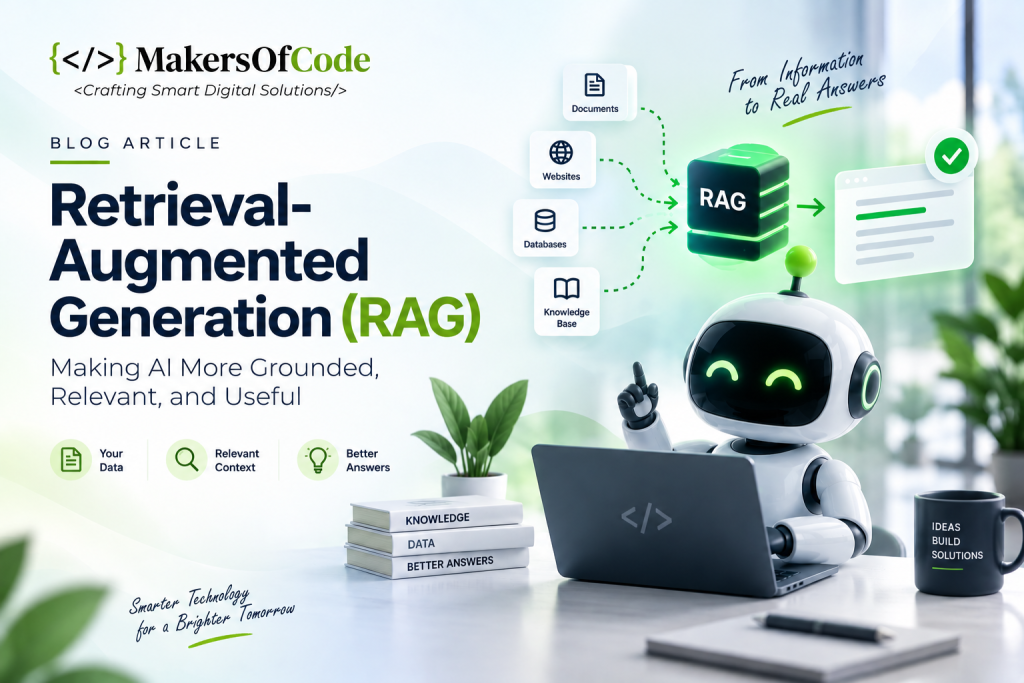
Rather than expecting an AI model to know everything, RAG allows it to retrieve relevant information from an external knowledge source and use that information while generating a response.
That shift—from remembering information to retrieving information when needed—has become an important approach to building practical AI applications.
What exactly is RAG?
Retrieval-Augmented Generation is an architecture that combines two capabilities:
- Information retrieval — finding relevant information from an external source.
- Generative AI — using that information to produce a natural-language response.
In a conventional LLM application, a user asks a question and the model generates an answer based primarily on what it learned during training.
A RAG application introduces another step.
The system first searches a connected knowledge source for information relevant to the user’s question. The retrieved information is then supplied to the language model as context. The model uses that context to formulate the final response.
A simplified flow looks like this:
User Query → Retrieve Relevant Information → Provide Context to LLM → Generate Response
The model is still responsible for understanding and generating language. The retrieval system provides the information it needs to answer within a particular context.
A Simple Example
Consider an organization with hundreds of internal documents covering HR policies, employee benefits, leave rules, security procedures, and operational guidelines.
An employee asks:
“How many days of leave can I carry forward to next year?”
A general-purpose AI model cannot be expected to know the company’s internal policy.
With RAG, the application can search the organization’s approved documents, locate the relevant leave-policy section, and provide that content to the LLM.
The model can then respond based on the retrieved policy.
The important point is that the AI didn’t need to memorize the company’s entire documentation.
It looked up the relevant information at the time of the question.
This same principle can be applied to product documentation, customer support, software documentation, research material, contracts, knowledge bases, and many other information sources.
How a RAG System Works
A production RAG system usually involves several components working together. Although implementations vary, the process can generally be understood through two phases: building the knowledge base and answering user queries.
1. Preparing the Knowledge Base
The process begins with the information the AI application needs to understand.
This information might come from:
- PDF and Word documents
- Websites
- Product manuals
- Internal knowledge bases
- Databases
- FAQs
- Technical documentation
- Company policies
- Structured business data
Before this information can be retrieved effectively, it needs to be processed.
2. Chunking the Content
Large documents are generally divided into smaller pieces called chunks.
For example, a long technical manual could be divided into sections covering installation, configuration, troubleshooting, authentication, and API usage.
The goal is not simply to split text into arbitrary pieces. Good chunking attempts to preserve enough context for each section to remain meaningful while keeping retrieval precise.
This is one of the areas where RAG implementations can differ significantly.
3. Creating Embeddings
The chunks are then converted into numerical representations known as embeddings.
An embedding represents the semantic characteristics of a piece of content in a mathematical form.
This allows the system to identify content that is conceptually related, even when the wording is different.
For example, a user might search:
“How can I change my account password?”
while the documentation says:
“Instructions for updating user credentials.”
A semantic retrieval system can recognize that these are related concepts even though the exact words don’t match.
4. Storing the Information
The embeddings and associated information are stored in a system that supports similarity search.
This may be a dedicated vector database or a conventional database/search platform with vector-search capabilities.
Metadata can also be stored alongside the content—for example:
- Document name
- Department
- Product
- Date
- Access level
- Document version
This metadata becomes useful when the application needs more controlled retrieval.
5. Retrieving Relevant Content
When a user submits a question, the query is processed and used to search the knowledge base.
The system identifies the pieces of information that are most relevant to the question.
In more advanced implementations, retrieval can involve several techniques, including semantic search, keyword search, metadata filtering, and reranking.
The objective is straightforward:
Give the language model the right information—not simply more information.
6. Generating the Response
The retrieved content is passed to the LLM along with the user’s question.
The model can then generate an answer using the retrieved context.
This is where the two parts of RAG work together:
Retrieval finds the information.
Generation turns that information into a useful response.
Why RAG Has Become Important
The growing interest in RAG is closely connected to the way organizations are adopting generative AI.
Businesses rarely want an AI assistant that only answers general questions. They want AI to work with their specific information.
That could mean a support assistant trained around product documentation, an internal knowledge assistant connected to company policies, or a developer assistant that understands an organization’s technical documentation.
RAG provides a practical way to connect these information sources with modern language models.
Keeping Information Current
One of the advantages of RAG is that the knowledge source can be updated independently of the underlying language model.
If a company releases a new product manual, the new document can be processed and added to the knowledge base.
There is no inherent need to retrain the entire language model simply because a document has changed.
Working With Private Knowledge
Organizations often have information that isn’t publicly available.
RAG applications can be designed to retrieve information from authorized internal sources, making them useful for enterprise-specific AI experiences.
However, this requires proper authentication, authorization, data isolation, and security controls. RAG itself does not automatically make private data secure.
Reducing Unsupported Answers
Generative AI models can sometimes produce plausible-sounding information that isn’t supported by reliable evidence.
RAG can help address this by supplying relevant source material to the model.
It is important to understand the distinction, though: RAG does not eliminate hallucinations. Poor retrieval, incomplete documentation, ambiguous questions, or weak prompts can still result in inaccurate responses.
The quality of the retrieved information remains critical.
RAG and Fine-Tuning Are Not the Same
RAG and fine-tuning are sometimes treated as competing approaches, but they solve different problems.
Fine-tuning modifies a model’s behavior by training it further on a specialized dataset.
It can be useful when an application needs a particular response style, behavior, format, or task specialization.
RAG, on the other hand, supplies external information to the model at inference time.
A useful way to think about the difference is:
Fine-tuning changes how the model behaves.
RAG changes what information the model can access while answering.
In some applications, both approaches may be used together.
Where Can RAG Be Used?
The applications of RAG extend far beyond the familiar AI chatbot.
Customer Support
A support assistant can retrieve information from product manuals, FAQs, troubleshooting guides, and support documentation before responding to a customer.
Enterprise Knowledge Management
Employees can ask natural-language questions about internal policies, procedures, documentation, and company resources instead of manually searching through multiple systems.
Developer Assistants
Development teams can connect AI assistants to API documentation, architecture documents, coding standards, repositories, and internal technical knowledge.
Document Analysis
RAG can help users locate relevant information across large collections of business documents, research material, contracts, and reports.
Education and Training
Organizations can build assistants around training material, course documentation, learning resources, and institutional knowledge.
Research
Researchers can use retrieval-based systems to search large collections of papers, reports, documentation, or other approved information sources and interact with the retrieved material conversationally.
The Hard Part Isn’t Just Adding a Vector Database
One of the misconceptions surrounding RAG is that building one simply means uploading documents, generating embeddings, connecting a vector database, and attaching an LLM.
A basic prototype can certainly be built that way.
A reliable production system is more complicated.
The quality of a RAG application depends heavily on the quality of its retrieval pipeline.
If documents are poorly parsed, important information may be lost.
If chunks are badly structured, relevant context may not be retrieved.
If retrieval returns irrelevant content, the language model receives poor context.
And if the model receives poor context, the final answer may also be poor.
For this reason, production RAG systems often require careful attention to:
- Document processing and parsing
- Chunking strategies
- Embedding models
- Hybrid search
- Metadata filtering
- Retrieval ranking
- Reranking
- Prompt construction
- Context management
- Access control
- Source attribution
- Evaluation and monitoring
The lesson is simple:
RAG quality depends on retrieval quality as much as generation quality.
What Does the Future of RAG Look Like?
RAG is already evolving beyond the basic “search a document and answer a question” architecture.
Modern systems are exploring more sophisticated approaches, including hybrid retrieval, query rewriting, reranking, multimodal retrieval, graph-based retrieval, agentic workflows, and real-time data access.
This opens up interesting possibilities.
An AI assistant may not only retrieve a paragraph from a PDF. It could potentially combine information from documentation, databases, APIs, structured business systems, and other sources to answer a more complex question.
For example, instead of simply asking:
“What is our refund policy?”
a future enterprise assistant could potentially retrieve the relevant policy, check applicable product information, verify the customer’s context through authorized systems, and explain the applicable process.
At that point, RAG becomes less about building a chatbot and more about creating an intelligent interface over an organization’s information ecosystem.
RAG Is Becoming a Foundation for Practical AI
Generative AI has demonstrated that machines can communicate with people in remarkably natural ways.
RAG addresses a different challenge:
How can that intelligence work with information that matters to a specific organization, product, or user?
By connecting language models with external knowledge sources, RAG provides a practical architecture for building AI applications that are more contextual and grounded in domain-specific information.
It is not a replacement for good data management, security, search technology, or human oversight. It is a layer that brings these capabilities together with generative AI.
And that is perhaps what makes RAG so important.
The future of enterprise AI may not depend on building a model that knows everything.
It may depend on building systems that know where to find the right information, when to retrieve it, and how to use it responsibly.
That is the real promise of the Retrieval-Augmented Generation.